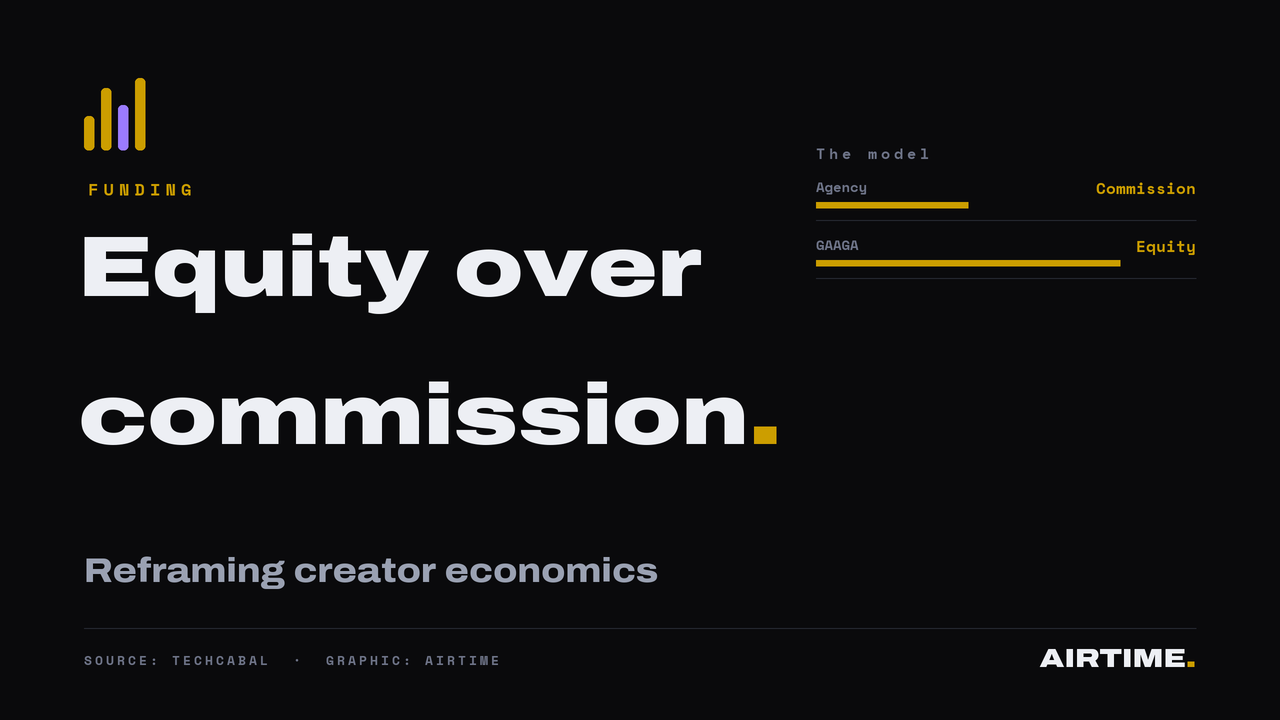
GAAGA World, a Lagos-based startup, has built a platform combining revenue-share investment with IP licensing for African creators. The model targets a structural problem: traditional agencies capture a percentage of creator earnings and offer no ownership stake, whilst African audiences earn less per listen than global audiences. GAAGA's pitch is that equity participation aligns incentives between investor and creator, and that a dedicated image rights licensing platform creates a new revenue stream for creators whose work crosses media formats.
The growth of professional creator infrastructure across Africa has produced a familiar problem: the money moves to the middleman. Platforms take a cut; agencies take a cut; rights clearance houses take a cut. The creator keeps what remains.
GAAGA World, according to reporting in TechCabal, is proposing a different arrangement. The company describes its model as "revenue-share and IP equity", with an image rights licensing platform in active development. The play, in short, is that instead of taking commission, GAAGA takes a stake, and that instead of surrendering image and likeness rights to a platform, creators retain them and licence them directly.
Revenue-share investing is not new in African tech, but its application to audio and podcast production is. The structural incentive problem it addresses is real: Nigerian and Kenyan podcasters earn significantly less per listener than US or European equivalents, because of advertising rate differences tied to audience wealth. A creator whose audience is 80 per cent Lagos-based will find their per-listener rate undercut relative to the same audience in San Francisco. Equity participation changes the economics: an investor with a stake in the creator's success, across all revenue streams and formats, is motivated to help the creator build beyond podcasting into visual content, live events and licensing.
The company describes its model as revenue-share and IP equity, targeting the structural pay gap created by geography-based advertising rates.
The business model depends on scale. If GAAGA assembles a portfolio of African creators working across audio, visual and written formats, it can aggregate those portfolios for brand partnerships, commercial licensing and broader media distribution. A creator alone might licence their voice to a single podcast; a portfolio of 50 creators becomes a media asset that a global brand will negotiate with.
The company is positioning itself as "the Y Combinator for African creators". That framing is deliberate: Y Combinator does not take permanent ownership of its portfolio companies, it takes a stake and helps them grow. The analogy suggests that GAAGA is not trying to be an agency or management company, but rather an early-stage investor in creator-led businesses. Whether the market sees it that way will depend on execution and track record.
GAAGA's announcement is self-reported, and the image rights licensing platform is described as "in development". The company has not named client creators or disclosed traction metrics. These are normal for an early-stage startup pitch, but they are worth noting: the value of the model rests on the execution of the licensing platform and the ability to sign creators willing to give up traditional agency representation. Both are harder than the pitch suggests.