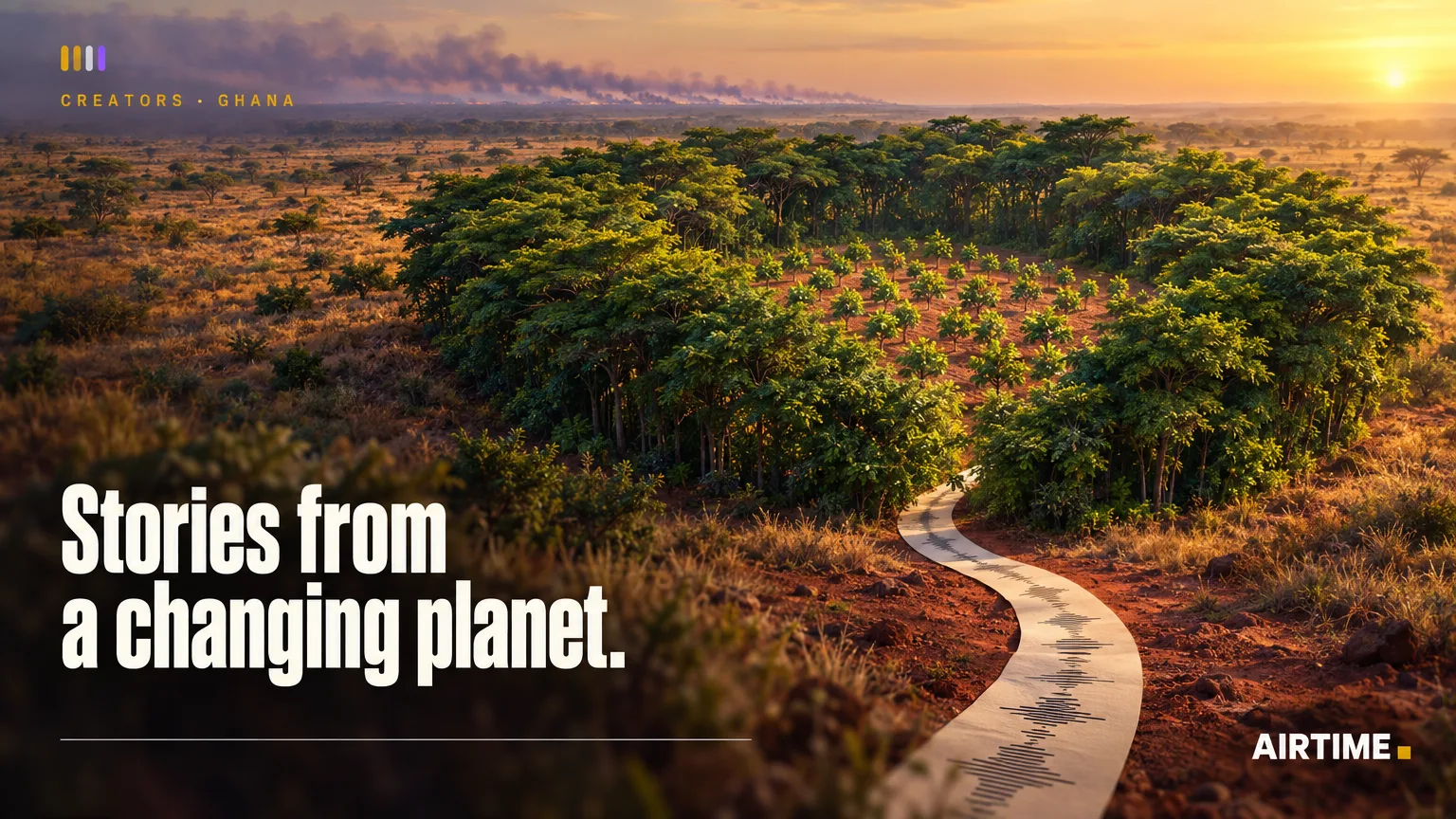
Nature Answers: Rural Stories from a Changing Planet is in its fourth season. According to its public RSS feed, a Season 4 trailer went out on 30 September 2026 and five full episodes followed between 1 and 29 October, all set in Ghana.
Farm Radio International describes Nature Answers as "a podcast from Farm Radio International that shares stories from rural communities in sub-Saharan Africa, where some of the most vulnerable people on earth are turning to nature for solutions to a changing climate." Ivy Prosper hosts. The show's feed description says she took listeners to "her home country, Ghana" in an earlier season, alongside Uganda, Côte d'Ivoire and Zambia. Season 3 ended on 18 June 2026 with an episode from Zambia.
The five Season 4 episodes
The feed tags each new episode as Season 4. Episodes run between about 16 and 23 minutes.
- Rooted in the Sand (1 October). A coastal committee in Ghana's Volta region turns to coconut plantations to stabilise the sand. The episode notes say the community of Vodja "has already lost 90% of its land mass to rapid sea erosion."
- The Root Cause (8 October). Communities in Vodza and Agido restore mangroves in the Keta Lagoon to rebuild fish spawning grounds. A local committee "has already planted more than 500 mangroves", according to the notes.
- From Ash to Assets (15 October). Farmers in Kamonaayili, northern Ghana, use biochar, "made from burned plant waste, to improve soil fertility, retain moisture and increase crop yields."
- Harvesting Hope (23 October). Farmers in Langogu, in the Northern Region, use water from a community dam to grow vegetables through the dry season.
- Fighting Fire with Forests (29 October). Farmers in Kokofu, Bono East Region, plant "firebelts, walls of trees surrounding their crops, to protect their farms from fires and strong winds while helping restore rainfall patterns."
The figures above are the producers' own descriptions of the communities they visited.
How the season was made
The latest episode's page says the show "is made in partnership with Carleton University's School of Journalism and Communication. Journalism students from the school were hired to spend 2-3 months in Ghana in 2026 to conduct interviews and tell these stories in partnership with broadcasters and Farm Radio International's staff members."
Local radio is part of the production. Episode notes credit support from Farm Radio International's Accra office and from community stations: Atoobu FM in Atebubu, Zaa Radio in Tamale for translation, and Jubilee Radio in Vodza. The feed notes for each episode describe it as "a Farm Radio International podcast produced thanks to funding from the Government of Canada."
The season's editor, John McGill, also explains a practice that other documentary producers may recognise: "Farm Radio International compensated community members who participated in our interviews." He says the podcast "would exclude many important perspectives if we could only interview those who could afford to step away from their economic activities without compensation."
Why it matters for podcasting
Nature Answers is a field-reported documentary series built around rural African voices, with interviewees often heard in translation. It is a useful model for producers who want to tell stories from places that rarely reach podcast charts, and it shows community radio working alongside a podcast rather than competing with it. The show is listed on Apple Podcasts, Spotify, Pocket Casts, Castbox and YouTube, as well as its RSS feed. Airtime has also reported on another series drawing on research in Ghana, the ID-OLOGY research podcast.