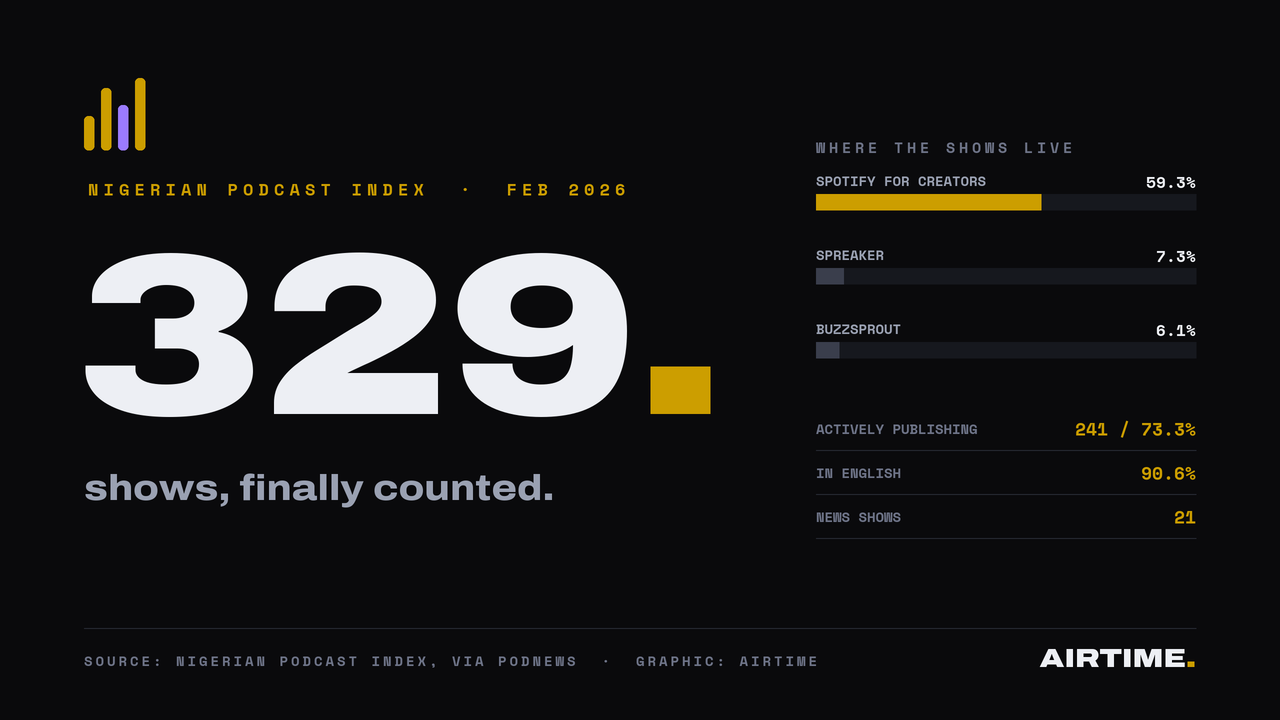
Launched in February by Lagos audio strategist Tony Onwuchekwa, the Nigerian Podcast Index has catalogued 329 shows: 241 actively publishing, 90.6 per cent in English, and 59.3 per cent hosted on Spotify for Creators. It is the first manually verified census of Nigerian podcasting, and its sharpest finding is about plumbing, not size.
For years, the size of Nigerian podcasting was folklore. Everyone in African audio agreed the market was big, young and loud; nobody could put a number on it. Now somebody has counted. The Nigerian Podcast Index, launched on 12 February 2026 by Tony Onwuchekwa, the Lagos-based media consultant and podcast industry analyst better known as Tony Doe, is a public, independent directory built the unglamorous way: creators submit their shows through a form, every listing is verified by hand, and only feeds that actually work make the cut. Its stated aim is to document, preserve and make discoverable "every independent podcast created in Nigeria or by Nigerians".
The first snapshot, published via Podnews, counts 329 podcast titles. Of those, 241, or 73.3 per cent, are actively publishing; 88 are inactive or on hiatus. Podnews' accompanying analysis frames the stakes plainly: this is Africa's largest English-language audio market taking shape in a country of roughly 223 million people.
The language split is the first surprise. English carries 90.6 per cent of indexed shows. Yoruba holds 3.6 per cent, Igbo 2.4 per cent and Hausa 2.1 per cent, in a country where each of those languages is spoken by tens of millions of people. Read one way, that is a ceiling. Read the trade's way, it is one of the largest unserved audiences in global audio, sitting in plain sight with almost no competition.
The platform data is the finding with teeth. Spotify for Creators, the free hosting arm formerly known as Anchor, hosts 59.3 per cent of indexed shows, 195 in all. Spreaker takes 7.3 per cent and Buzzsprout 6.1 per cent, with the pan-African platform Afripods among the domestic alternatives holding low single digits. The index's own release names the risk without decoration: a "platform dependency that limits distribution resilience". Three in five Nigerian podcasts sit on one company's free infrastructure, on terms that company can change.
The census's sharpest finding is not how many shows exist. It is how much of the market rents its foundations.
The genre table sketches the market's shape. Society and culture leads with 113 shows, religion and spirituality follows with 94, then education with 33, business with 32 and news with 21. Two thirds of Nigerian podcast output is conversation about life and faith, which tracks the country's radio heritage. The thinner end of the table is the commercial opening: twenty-one news shows in a country of 223 million is not saturation, it is a vacancy. The index's standard-bearers are familiar names to anyone reading this site: I Said What I Said, which Podnews calls the continent's most successful independent podcast, the music-industry interview show Afrobeats Intelligence, and the true-crime feed 23419, all three already listed in the Airtime directory.
There is a wrinkle, and it is an instructive one. At the time of writing, the index's own website, nigerianpodcastindex.com, resolves to a suspended-hosting notice, with the public record living on in its founder's newsletter and the trade press. Hosting interruptions happen to small independent projects and this one may be resolved by the time you read this. But for a dataset whose headline warning is about fragile distribution, the outage makes the point better than the press release could: Nigeria's podcast record currently depends on one volunteer's diligence and a single hosting account. Archives need resilient plumbing too.
What changes now is that the argument has a baseline. Brands weighing Nigerian audio, researchers mapping African media and platforms deciding where the next pop-up goes all have a verified count to start from, with a named methodology and a founder willing to show his workings. And 329 is not a large number for 223 million people. That is precisely the point. Counted, the gap stops being folklore and becomes addressable.