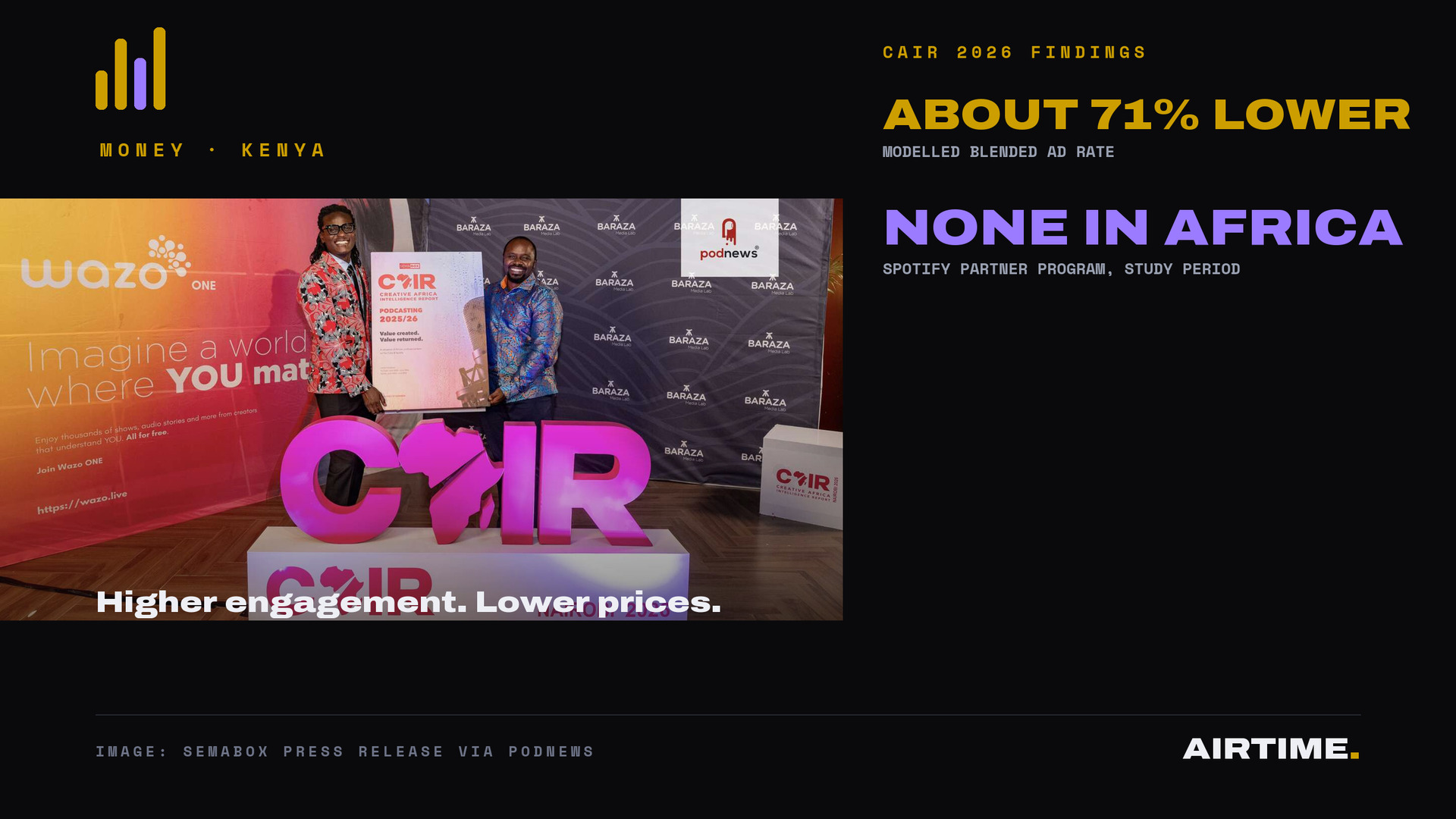
SemaBOX wants Spotify to test its podcast payment programme in Africa. Its Creative Africa Intelligence Report 2026, launched on 20 October, says Spotify "should test a phased African rollout, beginning with high-activity markets such as Kenya, Nigeria and South Africa." According to SemaBOX's press release on Podnews, the report was launched in Nairobi in partnership with Baraza Media Lab.
The access gap
The recommendation rests on what the report calls an access gap. "During the study period, Spotify's Partner Program was unavailable in every African market, and YouTube's Partner Program was available in only 13 of Africa's 54 countries," the press release says. The report itself adds that, as of 12 October 2026, Spotify's programme "is available in 19 markets, none of them in Africa", and that Spotify's announced expansion from 20 October "still contains no African market". That matches Airtime's reading of Spotify's 37-market expansion, and YouTube's own list of 13 African countries is covered in our YPP explainer.
The report says any pilot "should measure creator participation, eligible consumption, advertiser demand and payout performance before wider expansion." It also asks both platforms to publish aggregated country-level data on realised advertising rates, inventory fill, audience geography and creator payouts.
The 'geography discount'
The report's central figure is a modelled price gap. According to the press release, the YouTube sample "recorded a weighted engagement rate of 2.75%, compared with a benchmark of 1.5% to 2.2% in higher-paying markets". Even so, "the sample's blended advertising rate is about 71% lower than the comparator."
SemaBOX puts the gap at "about twofold in South Africa and about sevenfold in Nigeria and Kenya". It "reaches almost elevenfold in Ghana, Uganda, Tanzania, Senegal and Egypt", but there the report applies a shared fallback rate "because no reliable country-specific benchmark exists". The release says the gap is likely to widen, because the report estimates audiences are growing by 20% to 28% a year while the infrastructure to monetise them grows by 7% to 14%.
SemaBOX founder and CEO Dan Aceda said: "The geography discount is our biggest challenge, but it is also our greatest opportunity."
How to read the figures
These are estimates, not payout records. APVA, reporting the launch on 28 October, notes that the report is candid that they are "modelled estimates drawn from a sample chosen partly for high engagement, not verified creator payouts or a full census of African audio."
The sample is 330 pieces of content: 227 YouTube videos and 103 Spotify episodes. The press release says it generated "more than $0.9 million in advertising value" at local rates. The report's executive summary gives a higher figure, $1,045,149. Airtime examined that discrepancy and the report's rate inputs on 19 October, including Kenya's single-source rate.
For creators, the useful part is less the headline percentage than the list of asks. Beyond Spotify and YouTube, the release says the report urges investors to prioritise "dynamic ad insertion, audience measurement, catalogue aggregation and creator payment systems", and asks policymakers to set transparency standards for ad rates, fill rates and creator payouts.