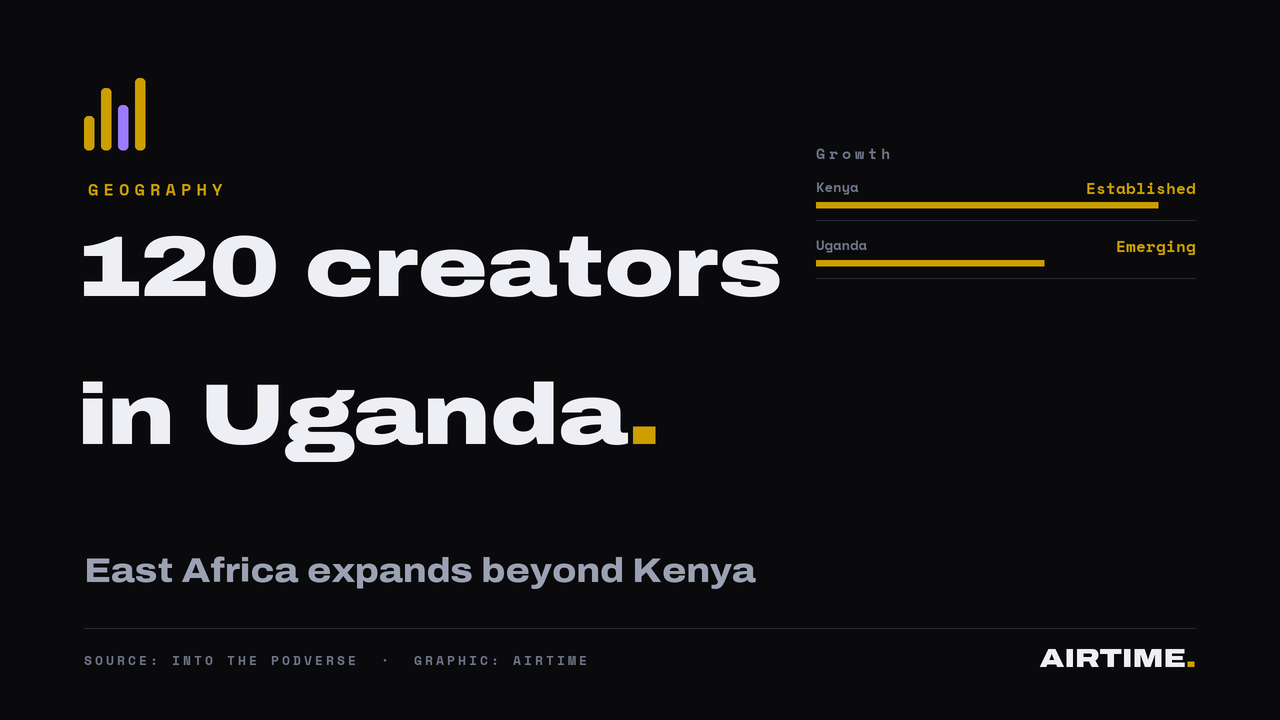
According to reporting from Into the Podverse, Uganda has reached approximately 120 active podcast creators. The figure matters less for its absolute size than for its geography: secondary East African markets reaching operational scale is a signal for advertiser expansion and platform investment decisions. Kenya has been the East African podcast hub for years. Uganda crossing into the 100-plus range suggests the region is generating its own creator infrastructure, separate from Kenya's established scene.
African podcast industry conversation tends to consolidate around Nigeria and Kenya. Nigeria's size, Kenya's infrastructure stability. Everything else becomes an afterthought or a data point in a "rest of Africa" category.
That categorisation is starting to crack. Into the Podverse, a podcast industry newsletter, reported in July that Uganda now has approximately 120 active podcast creators. The number is not large in global terms. But the shape it describes is worth attention: a secondary East African market crossing a threshold into platform-building critical mass.
What that threshold means depends on context. 120 creators does not guarantee 120 shows that reach audiences or generate revenue. Nor does it predict sustainability; many shows go dormant as creators move to other platforms, jobs or countries. But it does mean that Uganda has crossed into a zone where advertising networks have a reason to build inventory, where sponsorship partnerships become viable, and where the infrastructure of podcasting - hosting services, analytics platforms, distributor integrations - has a market to serve beyond individual enthusiasts.
Kenya's podcast ecosystem, by comparison, has matured over nearly a decade. Nairobi has hosting providers, production studios, listener bases and advertiser relationships that amount to a functioning market. Uganda's 120 creators are not yet there. But the fact that a separate count exists - that someone in the industry is tracking Uganda specifically, rather than lumping it into "rest of Africa" - is itself a signal that the market is becoming disaggregated and worth tracking granularly.
Uganda crossing 120 active creators signals an emerging secondary market becoming worth investors' and advertisers' infrastructure investment.
There is an economic and social dimension here as well. Uganda's podcast growth occurs in a context of rapid mobile data expansion and rising middle-class audio consumption. Podcasts are not the primary format yet; music streaming and radio still dominate. But they are no longer fringe. A creator economy is building that does not depend on Nigeria's scale or Kenya's legacy infrastructure.
The caveat is important: the 120 figure is single-sourced, reported by a newsletter rather than independent industry measurement. No published survey or census has counted Uganda's podcast creators independently. The number should be treated as directional rather than definitive; it is a credible industry observer's snapshot rather than an independently verified metric. But the direction it points is clear: East Africa's podcast ecosystem is no longer the story of Kenya, plus secondary markets waiting to be discovered.
For creators in Uganda, the implication is that the next 18 months will likely see increased platform attention, sponsorship opportunities and production infrastructure aimed at their market. For investors, it signals a secondary market entering the stage where small, profitable plays become possible. For media companies planning African expansion, it means a simple fact: you cannot cover East African podcasting by covering Kenya alone.