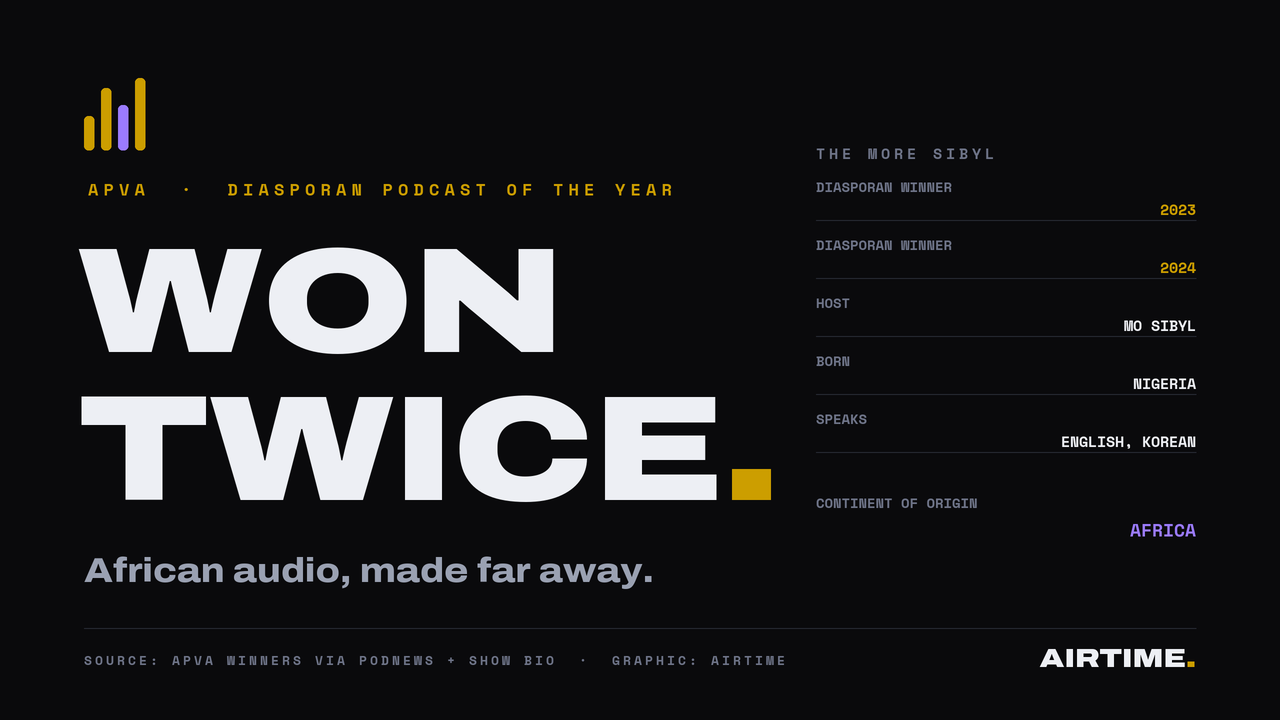
The African Podcast and Voice Awards run a Diasporan Podcast of the Year category. The More Sibyl Podcast has won it two years running, in 2023 and in 2024. Its host, Mo Sibyl, describes herself as Nigerian-born, US-educated and Korean-speaking, and the show is about culture and "culture nomads," made for, in its own words, Blacks and Asians and those who love them.
When we read the African Podcast and Voice Awards winners list as a map of the industry, the top-line result was that a South African business show took Podcast of the Year. Further down the same list is a category that says something the headline could not, because it describes where the edges of African podcasting actually reach.
The category is Diasporan Podcast of the Year, and the fact that it exists at all is the first data point. An awards body does not create a permanent category for a handful of entries. Its presence means the organisers see enough African podcasting made outside Africa to judge it as a field of its own, separate from the shows produced on the continent.
The winner is the second data point, and it is a better story than the category. The 2024 award went to The More Sibyl Podcast, hosted by Mo Sibyl, who describes herself as Nigerian-born, US-educated and Korean-speaking. The show is not about Nigeria in the way a Lagos conversation podcast is about Nigeria. It is about culture and what its host calls culture nomads, built explicitly for Black and Asian listeners and those between them, and its catalogue includes episodes in Korean. It won the same diaspora award the year before, in 2023, which makes it a repeat champion rather than a one-year surprise.
An awards body does not build a permanent category for a handful of entries. The diaspora lane is large enough to be judged on its own.
This matters for how the industry, and a directory like ours, thinks about the edges of the category. It is tempting to define African podcasting geographically, as shows made on the continent, and most coverage quietly does. The diaspora award is a standing argument against that definition. A Nigerian-born host talking about Black and Asian cultural life, in English and Korean, is African podcasting by the reckoning of the continent's own awards, twice over.
It also reframes the monetisation problem we keep returning to. We have written about how Spotify's payout programme names no African market, and how creators on the continent hit a wall built out of banking and geography rather than talent. A diaspora creator sits on the other side of some of those walls. Someone based abroad may have access to the payment rails, the ad markets and the platform programmes that a creator in Lagos or Nairobi does not, while still making work the continent claims as its own. The diaspora is not just a cultural extension of African podcasting. It may, for now, be the part of it that can most easily get paid.
The honest limits here are about the edges of what one award can tell you. A single category with a single repeat winner is a signal, not a survey, and we should not inflate it into a movement. Award results measure who entered and campaigned as much as who is best, and a diaspora with time, equipment and disposable income is more likely to submit to an awards process than a creator counting data bundles. We are also describing the show largely through its own self-description and its public award record, not a full independent profile. And the More Sibyl's own framing, culture nomads, Blacks and Asians, is a reminder that not every diaspora show is trying to be a Nigerian show at a distance. Some are making something the home-country map has no box for.
Still, the award does one useful thing. It draws the boundary of African podcasting wider than the four-city version the coverage usually implies, and it puts a specific, verifiable, two-time winner at the far edge of it. The next time someone maps this industry by its capitals, the diaspora category is the reminder that the map has a long tail, and that some of the most decorated work on it is being made a very long way from home.