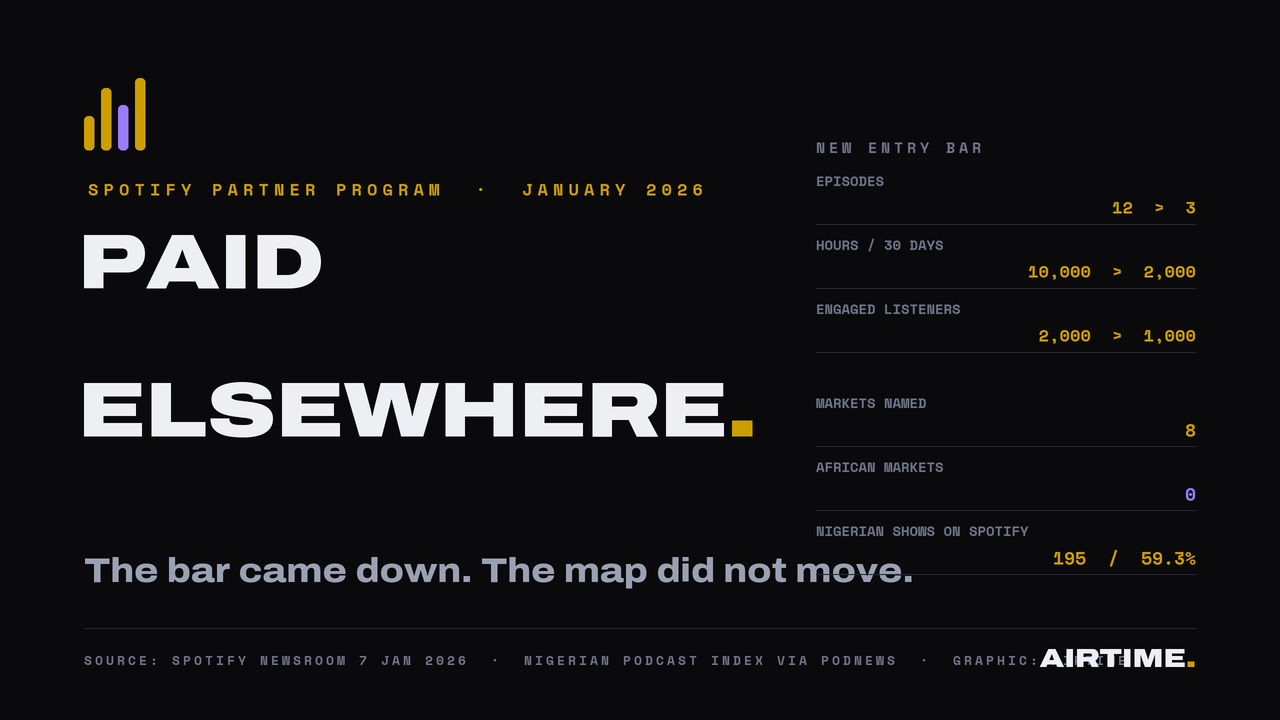
On 7 January Spotify lowered its Partner Program entry requirements from twelve episodes to three, from 10,000 consumption hours to 2,000, and from 2,000 engaged listeners to 1,000. The same announcement lists the markets where the programme runs: the United States, the United Kingdom, Canada, Australia, Sweden, Denmark, Finland and Iceland. Nigeria's podcast census, published five weeks later, found that 195 of its 329 indexed shows, 59.3 per cent, are hosted on Spotify for Creators.
Two documents published five weeks apart in early 2026 describe the same platform doing two different things, and reading them side by side explains a lot about why African podcasting struggles to convert audience into income.
The first is Spotify's own Partner Program update, dated 7 January. It is, on its face, generous. The qualifying bar for earning money on the platform dropped on all three measures at once: three published episodes rather than twelve, 2,000 consumption hours in the last thirty days rather than 10,000, and 1,000 engaged audience members rather than 2,000. A show that would have needed a year of publishing and a substantial audience to qualify can now clear the bar in a month. Spotify also flagged sponsorship management tools for April and a distribution interface that lets creators publish video from Acast, Audioboom, Libsyn, Omny and Podigee without moving house.
The second is the Nigerian Podcast Index, released on 12 February by the Lagos analyst Tony Onwuchekwa. It counted 329 Nigerian shows, 241 of them actively publishing, and found that 59.3 per cent of them, 195 titles, sit on Spotify for Creators. Spotify is not a bit player in Nigerian podcasting. On the hosting layer it is close to being the market.
The gap between the two documents is a list of country names. Spotify's announcement names eight markets where the Partner Program operates. Seven are in North America, Europe or Australia. Not one is African. So the tooling that Nigerian creators use to publish is free, excellent and available everywhere, and the programme that pays for the resulting listening is not available to them at all.
Hosting is global and free. Payment is geofenced. A Nigerian show can clear a threshold it is not eligible to be measured against.
This sharpens a warning the census already made. When the index reported that three in five Nigerian shows depend on a single host, the obvious reading was concentration risk: one policy change, one outage, one pricing decision, and most of a national industry is affected at once. The January announcement adds a second and less obvious problem. The platform they have concentrated on is one that, in their market, does not pay. The dependency is not just fragile. It is unpaid.
It also reframes what the lowered thresholds mean. A drop from 10,000 consumption hours to 2,000 is exactly the kind of change that would matter to a mid sized African show, the sort with a devoted audience of a few thousand that was never going to reach the old bar. Those are precisely the creators the new numbers were designed to bring in, and they are on the wrong side of the map.
The honest qualifications matter here. Spotify's announcement lists the markets where the programme runs; it does not say Africa is permanently excluded, and platforms expand these schemes over time. Programme availability can change without a press release, so any creator should check their own eligibility in the Spotify for Creators dashboard rather than take a list of eight countries as final. Nor is the Partner Program the only way to earn: direct brand sponsorship remains the main revenue route for African shows, and it is not gated by anyone's market list.
That last point is the connective tissue with everything else happening in Lagos. If platform payouts are unavailable, the money has to be sold by hand, which means someone has to package audiences, name a rate and invoice a brand. That is not a technology problem. It is an agency problem, and it explains why the arrival of a production and management layer in Nigeria this year is a bigger deal than it looks. Where the platform will not pay, the intermediary has to.
There are two things worth watching, and they are easy to check. The first is whether Spotify ever names an African market in a Partner Program update, which would convert a large hosted audience into a payable one overnight. The second is whether Nigerian creators start hedging, moving some distribution to Afripods or elsewhere, rather than leaving nearly six in ten shows on a service that hosts them for free and pays them nothing.
Until one of those happens, the numbers describe an odd arrangement. Nigeria supplies the shows and the listening. The payout list is somewhere else.