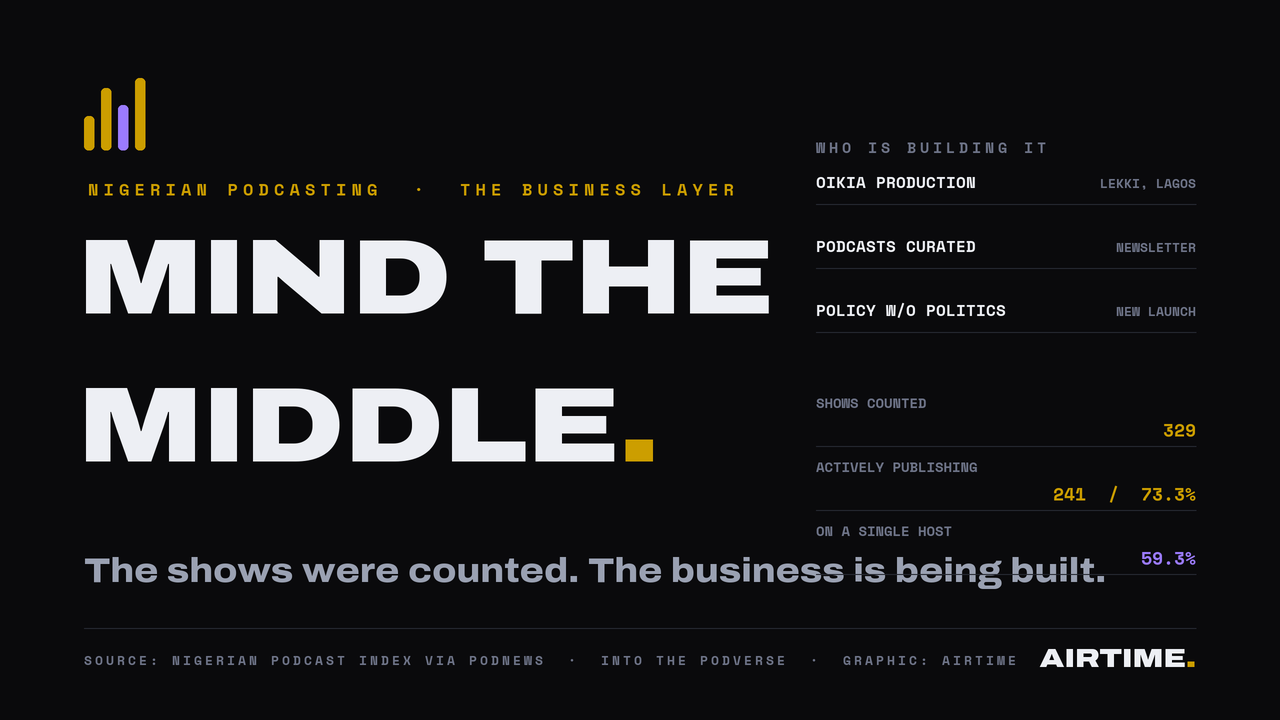
The Nigerian Podcast Index counted 329 shows in February, 241 of them actively publishing. Its sharpest findings were structural: three in five shows sit on one free host, and the market has thin commercial scaffolding. Six months on, that scaffolding is being built, in the unglamorous form of an agency in Lekki selling production, management and training.
In February, Nigerian podcasting stopped being folklore and became a number. The Nigerian Podcast Index, built by the Lagos analyst Tony Onwuchekwa, counted 329 shows: 241 actively publishing, 90.6 per cent in English, and 59.3 per cent hosted on Spotify for Creators. We wrote at the time that the census doubled as a to-do list. The item at the top of that list was never talent. It was plumbing and structure.
Six months is not long in an industry's life, but it is long enough for the first answers to show up. Reporting in the trade newsletter Into The Podverse on 17 July describes Oikia Production, a Nigerian podcast company founded by the producer and curator Damilola Oyeleke, as roughly six months old and already running workshops, a growing newsletter and community events, with plans for a larger creator community. The same reporting frames the wider problem in blunt terms: Nigeria has no shortage of talent, but weak structures, inconsistent institutional support and limited consumer spending keep slowing sustainable growth.
Oikia's own site describes a straightforward agency business rather than a movement. It bills itself as a branded podcast outfit working out of Lekki Phase 1 in Lagos, selling three things: production, where it handles "every stage" from planning and research through recording, editing and publishing; management, covering publishing, distribution and performance tracking; and training and consulting for in-house teams. Two engagements are named on the page, a food show made with Ounje Co and Coles Cooks, and Noisy Streets as a training client. There are no audience or revenue figures anywhere on it.
That modesty is the point, and it is why the development matters more than a funding headline would. A census tells you how many people own a microphone. An agency that sells training and management is the layer that turns some of those people into a business: someone to hand the editing to, someone who knows what a brand will pay for, someone tracking whether episode 40 outperformed episode 4. It is the least romantic part of a media industry and usually the last to arrive.
A directory tells you how many shows exist. It does not tell you how many will still be publishing next year. The business layer decides that.
There is a second signal in the same week, and it is about who is now willing to start a podcast. Into The Podverse reports the launch of Policy Without Politics, a weekly show on governance, economics and public policy from Mustafa Chike-Obi, a former bank executive, and the economist Ken Ikpe. Set that against the census genre table, where society and culture leads with 113 shows and religion and spirituality follows with 94, while news sits at 21. A former bank chairman and an economist starting a weekly policy show is a different species of entrant from the friends-with-microphones format that built the market. It suggests Nigerian podcasting is becoming a place where institutional voices expect to be heard, not just a place where young people talk.
The honest caveats are large. Oikia is about six months old on its own account, names two clients publicly and publishes no numbers, so nobody should mistake it for an industry. One agency and one policy show do not fix a market where three in five titles still rent their distribution from a single free platform, which was the census's real warning and remains completely untouched by any of this. Nigeria's own podcast index spent part of this month resolving to a suspended-hosting notice, a reminder that even the record-keeping is thinly funded.
What would count as genuine progress is measurable, and worth watching for. More than one agency competing, which means published rates and clients willing to be named. Shows surviving past their first year at a better rate than the census's 73.3 per cent active figure. And some movement off the single-host dependency, whether toward Afripods or anywhere else with terms a Nigerian creator can negotiate. None of that has happened yet.
The count made the gap addressable, which was always its value. The number worth watching next is not how many podcasts Nigeria has. It is how many of them are somebody's job.