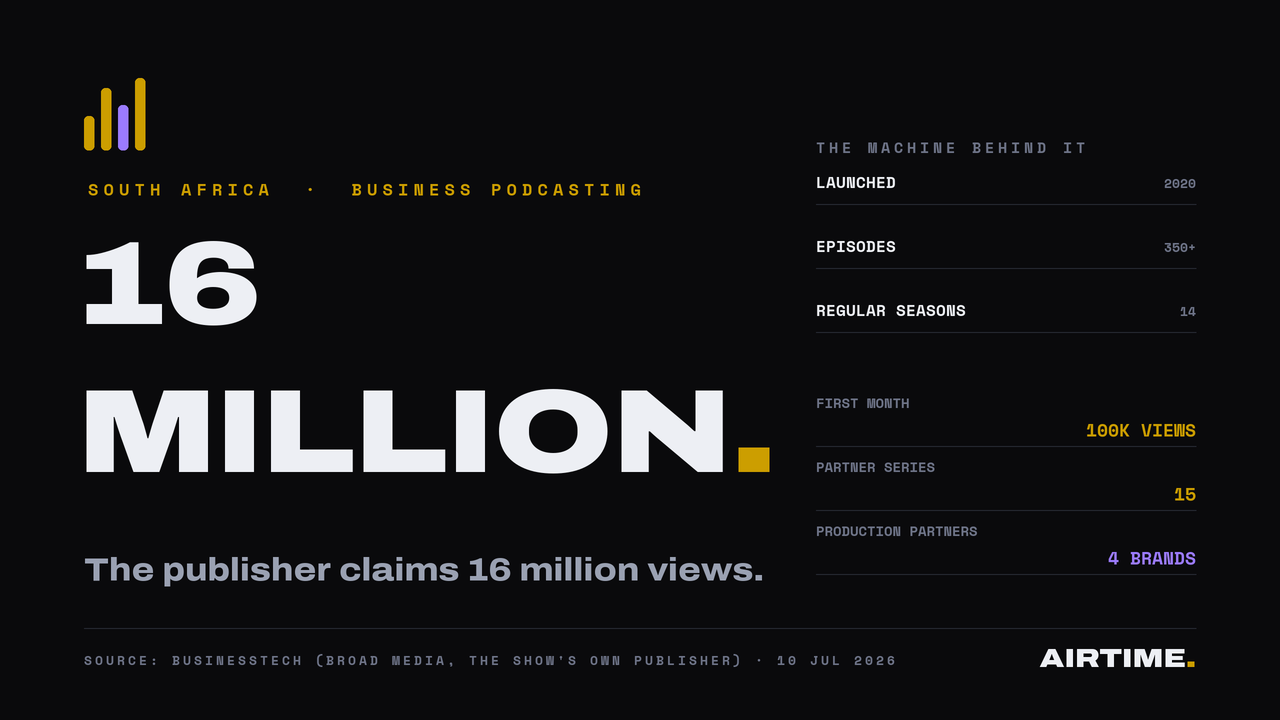
Broad Media says its Business Talk with Michael Avery has passed 16 million views since launching in 2020. Every figure comes from the publisher itself, so treat the total with care. What is independently visible is the model: named corporate partners buying whole series, not ad slots, and a B2B publisher using its own news site as the distribution engine.
South Africa's most-watched business podcast has a new number. Business Talk with Michael Avery has passed 16 million views, its publisher announced on 10 July, six years after launching in 2020 with what it says was 100,000 views in its first month.
The sourcing caveat comes first, because it matters. BusinessTech, which published the milestone, is owned by Broad Media, which also owns the show. There is no independent audit of the 16 million, and views spread across YouTube, Spotify, Facebook, LinkedIn and two of the publisher's own websites are not the same as listeners. Every figure in this piece is the publisher's own claim. We repeat them because the trajectory has been reported consistently for years, 8 million views was announced in earlier releases, and because even discounted heavily, the shape of the business underneath is real and unusual.
That shape is the story. Business Talk did not grow out of a bedroom or a comedy duo, the two origin stories that dominate African podcasting. It grew out of a B2B publisher bolting audio and video onto an existing news operation, with a professional financial journalist, Michael Avery, in the chair. The guest list reads like a JSE index: Standard Bank group CEO Sim Tshabalala, former FNB chief executive Michael Jordaan, JSE capital markets director Valdene Reddy, TymeBank's Tauriq Keraan. Fourteen regular seasons and more than 350 episodes later, it is less a show than a schedule.
The revenue model is visible in the credits: Sanlam, EY, Sage and Rand Merchant Bank do not buy thirty-second spots. They buy whole series.
Alongside the 14 regular seasons sit 15 exclusive partnership series, made with and for named corporates including Sanlam, EY, Sage and Rand Merchant Bank. That is the part most African podcasters should study. The dominant monetisation advice on the continent is still programmatic ads and listener support, both of which pay in cents. Business Talk's model is closer to sponsored publishing: a brand funds an entire themed series, the publisher guarantees production quality and an executive audience, and the economics stop depending on per-episode ad rates that African inventory rarely commands.
It helps to name what makes this hard to copy. Broad Media brings its own distribution, a B2B news site with an established readership, so every episode launches into an existing audience rather than hunting for one. The guests come through a newsroom's contact book. And the buyer side, corporate marketing budgets that already trust the publisher, was in place before the first episode aired. A creator with a microphone has none of those three things, which is why the playbook transfers to publishers and agencies more readily than to individuals.
The claim also lands in a market that measures itself loosely. South African podcasting has no equivalent of Nigeria's podcast census, no shared chart with audited numbers, and a habit of quoting platform-specific view counts as if they were audience sizes. Sixteen million views over six years, if accurate, averages out to modest but respectable per-episode numbers for a niche business audience, which is precisely the audience advertisers pay a premium to reach. The absence of independent measurement is the industry's problem, not this show's, but it is why every milestone in this market arrives with the word "claims" attached.
What the milestone genuinely demonstrates is that South African podcasting now has at least one fully professionalised, sponsor-funded operation that has survived six years and kept its named partners. For a market where most shows still measure their lifespan in months, that is the benchmark worth writing down, whatever the exact view count turns out to be.