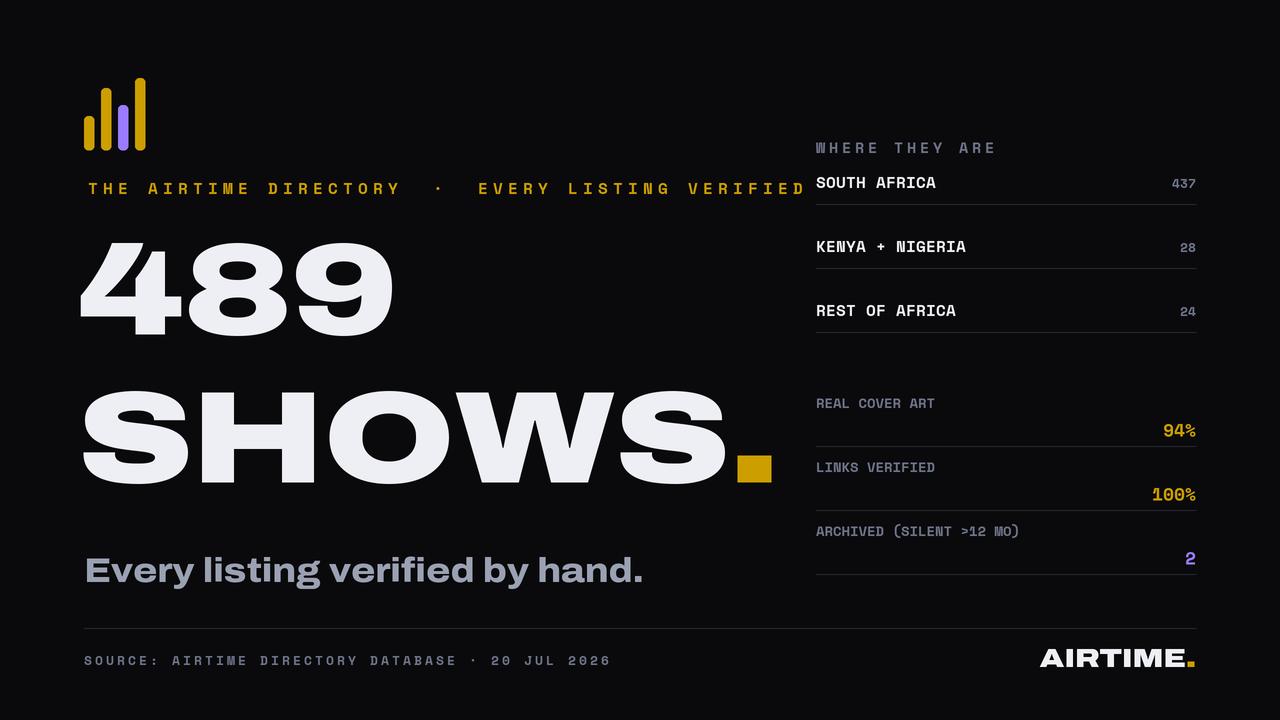
The Airtime directory now lists 489 African podcasts across eight countries, every one with a working link a human actually fetched. Getting there meant repairing or rejecting 32 broken listings, archiving 2 shows silent for over a year, and holding 5 we could not verify at all. This is first-party data about our own product, disclosed as such. The pattern underneath is an industry-wide discoverability problem.
A disclosure before a single number: the directory is ours. This is not independent research about the market, it is what we learned building and then auditing our own product, and it says as much about our sources as about African podcasting. The South African total, 437 of 489 shows, reflects where our deepest source material sits, not South Africa's actual share of the continent's output. Kenya lists 16, Nigeria 12, then Tanzania and Ghana with 6 each, Uganda 5, Zimbabwe 4 and 3 pan-African titles. Nigeria alone counted 329 shows in its own census, so nobody should read our country columns as a map of the market.
What is worth reading is what the verification pass turned up, because we checked things a listener never sees. Every one of the 489 listings now has a working link that a person on this desk actually fetched. That sentence cost more than it suggests: 32 listings, about one in fifteen, arrived with links that were blank, malformed or dead. The URL field of a community-maintained podcast list is where good intentions go to rot. We found entries whose "link" read simply "Spotify", or "YouTube, Facebook, TikTok", the digital equivalent of a business card that lists "phone" instead of a number.
Of those 32, we repaired 27 by tracing each show to a canonical platform page, usually Apple Podcasts, which doubles as proof the show is a real podcast rather than a channel with ambitions. Two turned out to be genuinely finished: one silent since June 2022, one since December 2020. They are not deleted. They sit in a new archive, labelled and dated, because a directory that quietly erases its dead is writing fiction about survival rates. Five listings we could not verify anywhere, so they are held off the site entirely until someone can. We would rather list 489 real shows than 494 with ghosts.
One in fifteen listings arrived broken. If a dedicated directory struggles to find these shows, imagine being a listener. Or a sponsor.
The genre table holds the least surprising finding, and the most commercial one. Society and culture leads with 126 shows, but business is second at 107, ahead of comedy at 43. The talk-show stereotype of African podcasting undersells how much of it is people explaining money, careers and companies to other people. That is the inventory advertisers say they want, sitting in plain sight.
Cover art told its own story about platform gravity. When we set out to give every show real artwork instead of a placeholder, the reliable route for two-thirds was Apple's public search API. For much of the rest, the only source was the show's own page on Spotify or YouTube, and a meaningful group now exists only on YouTube, qualifying as podcasts because YouTube's own Podcasts tab says so. A medium born on RSS is quietly becoming platform-resident, which is exactly the single-host dependency Nigeria's census flagged as its one weak point, wearing a different logo.
Ninety-four per cent of listings now carry real cover art, and the remaining six per cent wear a deliberately plain monogram tile rather than a fake. The freshness rule is now standing policy: a show with no episode in twelve months moves to the archive, visible but shelved. A twice-weekly automated sweep proposes new candidates, and every one still has to clear the same bar, a real podcast, African, on a platform we can fetch, before it renders.
None of this makes our directory the measure of African podcasting. It makes it something rarer: a list where every entry is known to be real, current and reachable, with the dead honestly labelled. The shelf is open, and if your show belongs on it, the desk reads everything.