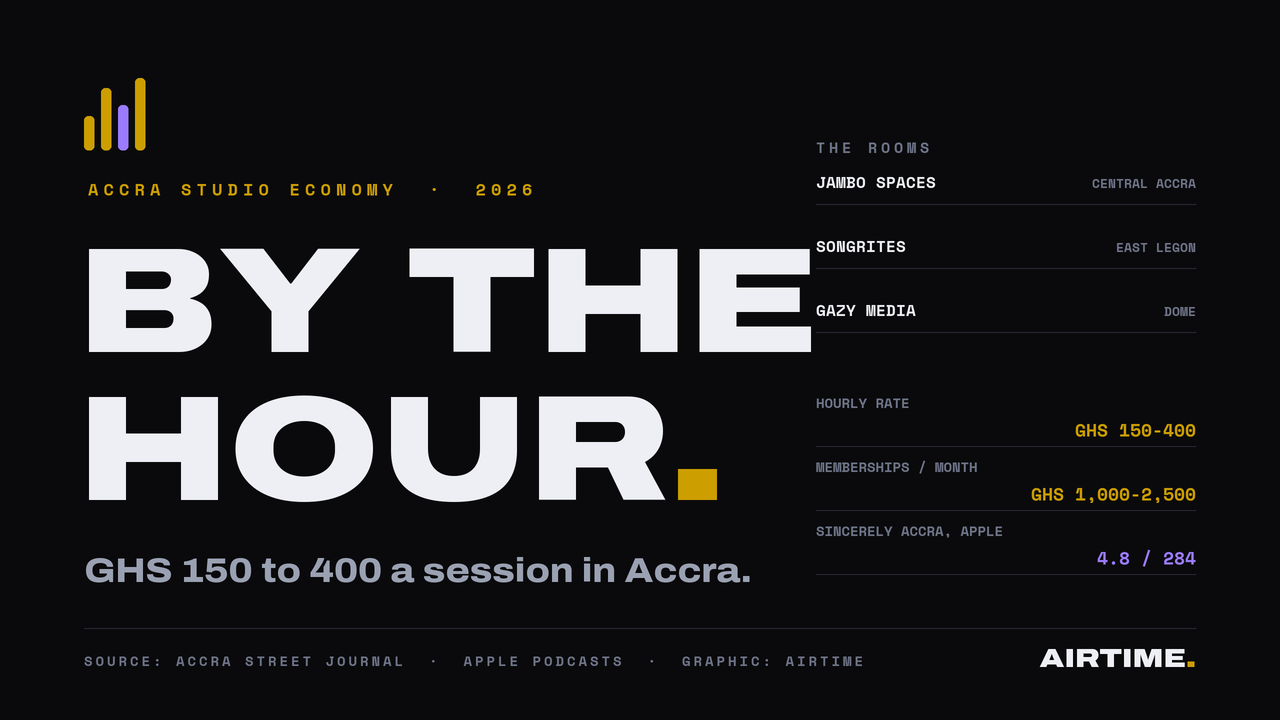
Accra's podcast studios charge GHS 150 to 400 an hour, with memberships from GHS 1,000 to 2,500 a month, according to the Accra Street Journal's survey of the city's recording spaces. Add distribution that routes through Boomplay as much as Spotify, and Ghana's scene looks less like a star system and more like an industry being assembled in the right order.
Every podcast market grows in its own order. Kenya built audiences first and venues followed. Nigeria built shows first and only counted them this year. Ghana, on the evidence of Accra's rental market, is building the middle layer: rooms you can book, rates you can plan around, and membership economics that turn a hobby into a line item.
The Accra Street Journal's survey of the city's podcast studios, first published in November 2025 and updated in March, reads like a price list for a functioning industry. Jambo Spaces runs a dedicated podcast room, the Trypod studio, inside a central Accra co-working space, alongside video production rooms and workshops. SongRites Studio in East Legon sells recording on a membership model, with flexible slots and stored sessions. GAZY Media Studio in Dome trades on professional equipment and acoustics, and rents the kit out when creators would rather record elsewhere. The going rate across the city's studios: GHS 150 to 400 an hour, with membership packages between GHS 1,000 and 2,500 a month.
Those numbers matter because they are legible. A creator in Accra can now cost a season the way a caterer costs a wedding: so many episodes, so many hours, one invoice. That is the difference between a scene that runs on borrowed bedrooms and one that can sign a sponsor and deliver on schedule. It is also a quiet bet by the studios themselves, because hourly rooms and monthly memberships only pay off if the city keeps producing people who want to record.
The demand side of that bet has form. The industry outlet Broadcast Media Africa, in a June essay on the continent's podcast economy, calls Africa the fastest-growing podcasting market in the world and also its least monetised, and tells the story of Nana Akosua Hanson, who launched a show from an Accra apartment in 2019 with a secondhand USB microphone. By 2023, as the outlet tells it, the show had passed two million downloads, signed a pan-African financial services sponsor and been licensed to three FM stations. The pipeline from bedroom to broadcast exists in Ghana. What the studio economy adds is a middle rung that does not depend on luck.
A creator in Accra can now cost a season the way a caterer costs a wedding: so many episodes, so many hours, one invoice.
Distribution is developing its own local accent. Alongside Spotify, which Broadcast Media Africa credits with more than 100,000 podcast titles of African origin, the same essay points to Boomplay, the music service with over 100 million registered users concentrated in Sub-Saharan Africa, emerging as a distribution partner for African shows, with the pan-African platform Afripods in the mix. For Ghanaian creators, that is a meaningful hedge: the audience that never opens Spotify is still reachable, on an app already on their phone. On the money side, the outlet puts programmatic audio rates for well-targeted African audiences at 15 to 40 dollars per thousand listens, which is the argument sponsors need to hear in a market it calls under-monetised.
None of this is happening in a vacuum. Ghana already has a standard-bearer with the mileage to prove the model: Sincerely Accra, the Gold Coast Report network's fast-paced show about life in the capital, hosted by Joseph Nti, has been running since 2018, publishes on a fortnightly Monday rhythm, and holds a 4.8 rating from 284 reviews on Apple Podcasts, where its mid-season review landed in late June. Eight years of continuity is its own infrastructure. It is also listed in the Airtime directory, holding Ghana's corner alongside the scene's newer arrivals.
The honest caveat is that a price list is not yet an industry. Nobody publishes utilisation figures for Accra's studios, and Ghana has no equivalent yet of Nigeria's podcast census to say how many shows the city actually sustains. But the direction is legible. Kenya proved African listeners will leave the house. Nigeria proved the shows exist in countable numbers. Ghana is proving somebody will invoice for the room. Of the three, the invoice may be the most underrated milestone.