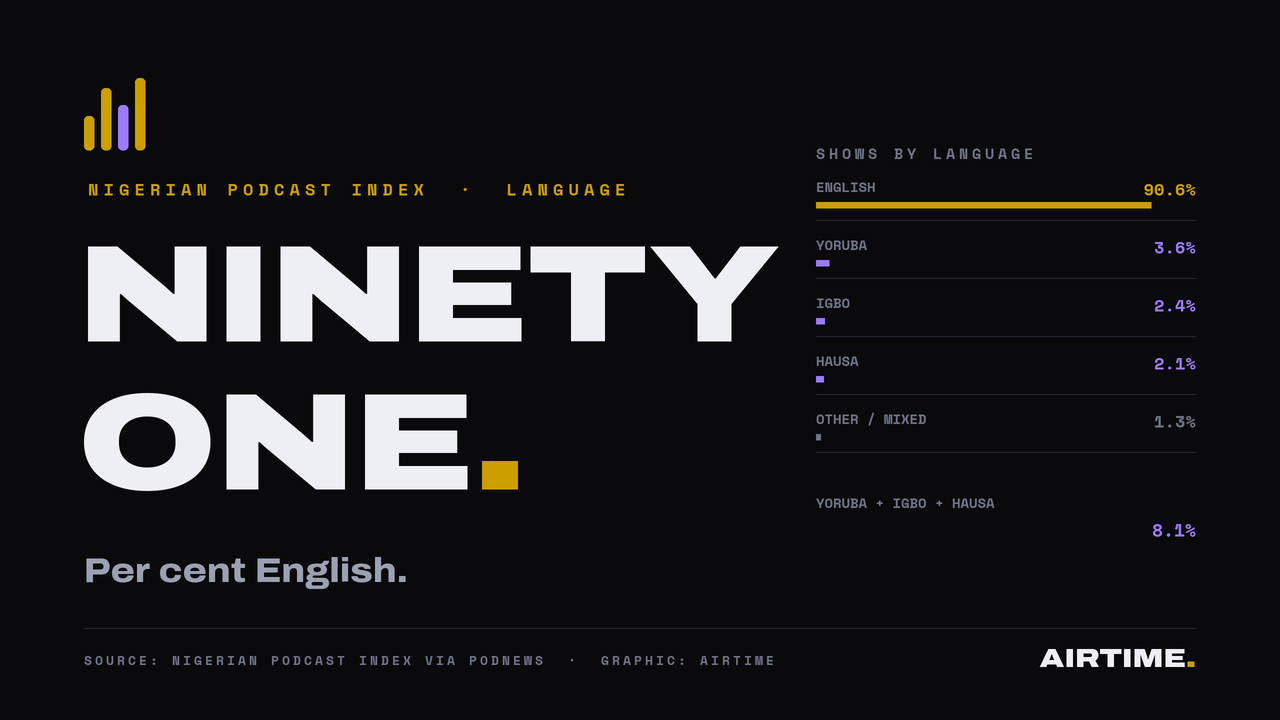
The Nigerian Podcast Index breaks its 329 shows down by language: English 90.6 per cent, Yoruba 3.6, Igbo 2.4, Hausa 2.1, and other or mixed 1.3. English is Nigeria's official language and its lingua franca, but it is the first language of only a minority of Nigerians. The country's podcasting is being made almost entirely in the language of school and business, not the language of home.
We have now pulled three findings out of Nigeria's podcast census: how many shows there are, which genres they fall into, and where they are hosted. The language table is the fourth, and it may be the one that says the most about who Nigerian podcasting currently serves.
The numbers are lopsided in a way that is easy to state and harder to sit with. Of the 329 shows the index counted, 90.6 per cent publish in English. Yoruba accounts for 3.6 per cent, Igbo for 2.4, Hausa for 2.1, and everything else, including mixed-language shows, for 1.3. Put the three largest Nigerian languages together and they reach 8.1 per cent of the country's podcasts.
To see why that is striking rather than obvious, you have to hold two facts next to each other. English is Nigeria's official language, the language of its schools, its courts and its business, and the natural common tongue in a country with hundreds of languages. It is also, for most Nigerians, a second language rather than a first. Hausa, Yoruba and Igbo are spoken as first languages by populations counted in the tens of millions each. A medium that is 90.6 per cent English is not reflecting how the country talks. It is reflecting who currently makes podcasts.
A medium that is nine-tenths English is not a map of how Nigeria speaks. It is a map of who has been able to make a podcast so far.
That distinction matters because it points at both a limit and an opportunity. The limit: podcasting in Nigeria has so far grown inside the English-speaking, urban, connected slice of the country, the same slice that has the smartphones, the data bundles and the exposure to the format. That is a real audience, but it is a fraction of the whole, and a medium that stays there has a ceiling built into it.
The opportunity is the mirror image. There is a very large Nigerian audience that consumes enormous amounts of Hausa, Yoruba and Igbo audio already, on the radio, and almost none of it in podcast form. Radio has understood this for decades. The census suggests podcasting has not yet, or has not yet found the people willing to make the shows. Whoever does is not fighting for a sliver of the crowded English comedy-and-conversation lane. They are addressing a first-language audience with almost no competition.
The caveats are important and we will not bury them. The index counts the language a show is tagged or published in, not the language spoken inside every episode, and Nigerian podcasting is full of shows that move fluidly between English and a local language mid-sentence, which a single-language tag flattens. It counts titles, not listening, so it cannot tell you whether the 8 per cent of non-English shows punch above or below their number in actual audience. And it is one analyst's metadata snapshot, not a national audio survey. A show tagged English with half its dialogue in Pidgin is doing something the table cannot see.
Even with those caveats, the shape is hard to argue with, because a language mix this skewed does not flip on tagging conventions alone. Nigerian podcasting today is overwhelmingly an English-language medium in a country that is only partly an English-speaking one. That is a normal way for a young medium to start, in the language of its earliest and most connected adopters. It would be an odd and self-limiting way for it to stay. The census counted the shows that exist. The most interesting Nigerian podcasts of the next few years may be the ones this table cannot yet see, because nobody has made them in the language most of the country actually thinks in.