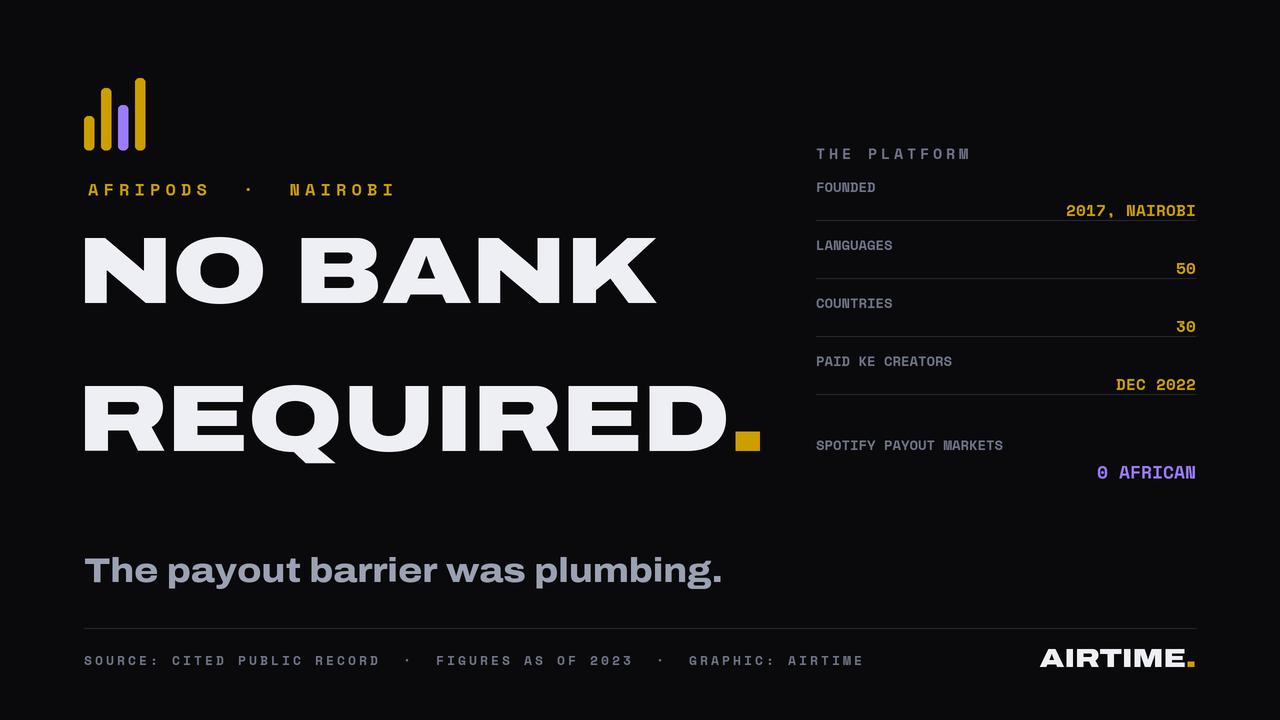
Afripods was founded in Nairobi in 2017 by Molly Jensen. It runs an advertising network, distributes to Spotify, Apple Podcasts and Stitcher, and as of 2023 carried shows in 50 languages from 30 African countries. Its most consequential claim is procedural rather than technical: it was the first African podcasting platform to pay creators directly, without requiring them to hold a US or European bank account.
Yesterday's story described a trap. Spotify cut its payout thresholds in January to three episodes and a thousand listeners, then named the eight markets where that money exists, none of them African, while its free hosting tool carries 59.3 per cent of the shows in Nigeria's podcast census. The obvious follow-up question is the one a working creator would ask. If not there, where.
The most established answer was built in Nairobi in 2017, and it is worth understanding precisely because its pitch was never about audio quality or analytics dashboards.
Afripods was founded by Molly Jensen, who has said her motivation was discomfort at relying on western media as an African. The platform distributes to the same places everyone else does, Spotify, Apple Podcasts and Stitcher, so using it does not mean surrendering reach. By 2023 it carried shows in 50 languages from 30 African countries. A 2022 assessment by Baraza Media Lab ranked it among the largest and most used homegrown podcasting platforms on the continent. It has institutional customers as well as independent ones: it partnered with Nation Media Group in 2021 to host podcasts, and from 2023 began converting radio broadcasts into podcast form.
None of that is the interesting part. The interesting part is that Afripods was the first African podcasting platform to pay creators directly without requiring a US or European bank account, and it began paying Kenyan creators hosted on it in December 2022.
The barrier was never the microphone. It was the bank account. A payout programme that assumes a US routing number excludes a continent before it reads a single download figure.
That detail explains more about African podcast economics than any market projection. Global platforms do not usually exclude African creators by writing them out. They exclude them structurally, by building payout rails that assume a bank in a country where the programme operates. A creator in Lagos or Nairobi with a genuinely valuable audience fails at the plumbing, not the performance. Removing the bank account requirement is unglamorous and it is the whole ballgame, in the same way that the arrival of an agency layer in Lagos matters more than a funding headline.
The caveats need stating clearly, and some of them are about the limits of what we could verify today. Afripods' own website did not return readable content when we fetched it, so the figures here come from the cited public record rather than a current company statement, and the 50 languages and 30 countries numbers date from 2023. We could not establish how many shows it hosts today, what its advertising network pays, or how those payouts compare with what an equivalent audience earns in a Partner Program market. Being paid directly is not the same as being paid well, and nobody should read this as a claim that the economics are solved. They are not.
There is also a competitive picture that is not settled. Boomplay reaches a very large Sub-Saharan audience and is increasingly discussed as a distribution route. Spotify's hosting remains free, excellent and, for now, the default in Nigeria. A creator choosing where to live is trading a global default that will not pay them against a regional platform that will, on terms neither party publishes in detail.
What we would want to know next is specific and checkable. What does Afripods actually pay per thousand listens, and how does that compare with the Partner Program rate in a market that has one? How many of the 195 Nigerian shows sitting on Spotify for Creators have ever tried an alternative? And will any global platform name an African market before a homegrown one takes the audience that the global platform declined to pay for?
The census told Nigeria how many podcasts it has. The payout map tells it who is willing to pay for them. So far the answer is a nine-year-old company in Nairobi.