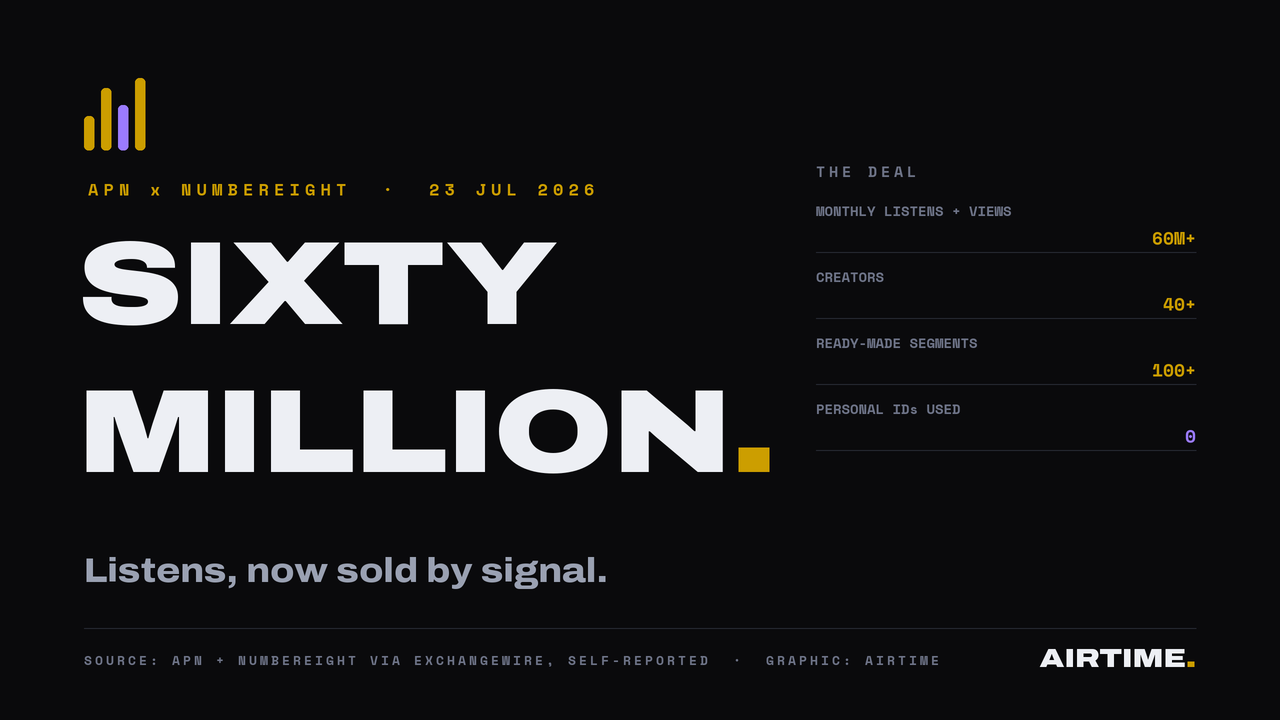
Africa Podcast Network, which reports more than 60 million monthly listens and views across 40-plus creators, announced a partnership on 23 July with NumberEight, an audience-intelligence company that builds targeting segments without personal identifiers. APN will offer advertisers more than 100 ready-made affinity audiences, from business leaders to football fans, making it by its own description the first podcast network in Africa to do so.
The persistent complaint about African podcast money is that the audience exists and the advertising machinery does not. We have covered the payout side of that gap: platform programmes that exclude African markets, and the homegrown platforms built to route around them. The announcement this week is about the other half of the machinery, the part that lets an advertiser buy an audience rather than a hunch.
On 23 July, Africa Podcast Network and NumberEight announced a partnership that makes APN, on its own description, the first podcast network in Africa to offer affinity audiences. The mechanics matter here. NumberEight styles itself an ID-less audience intelligence company: instead of tracking individual listeners, it models audience segments from contextual signals, what a show is about, and demographic modelling. APN says it will offer more than 100 such ready-made segments, business leaders, retail spenders, music lovers, football fans, across a network it puts at more than 60 million monthly listens and views from 40-plus creators.
The quotes attached to the release map who is at the table: Leigh Carter, APN's head of sales, on the Africa side; Abhishek Sen, NumberEight's co-founder and chief executive, entering the African market; and, notably, a vice-president from AdsWizz, the audio ad-tech firm, which suggests the delivery pipes this runs through are the established global ones rather than something bespoke.
Podcast advertising elsewhere grew up on tracking and is now painfully unlearning it. African podcast advertising gets to skip that stage.
Why this is worth a story rather than a shrug: targeting is the thing brand money waits for. An advertiser who can only buy "a podcast audience, somewhere" pays hobby rates. One who can buy "business decision-makers across forty shows" pays media rates. That is the difference between the sponsorship economy Nigerian creators describe, one direct deal at a time, and an actual market. And doing it without personal identifiers fits the African context unusually well, for two reasons. The pragmatic one: rich individual-level listener data barely exists across most of the continent, so a method that never needed it starts level instead of behind. The regulatory one: privacy regimes like POPIA and its cousins are tightening, and an ad layer that does not touch personal information has far less to fear from them.
The caveats are the standard ones for a vendor announcement, and they are real. Every figure here is self-reported: the 60 million listens, the 40-plus creators, the 54-country reach, and the "first in Africa" claim itself all come from the companies, and none is independently audited. No advertiser is named as signed. No pricing, revenue projection or creator revenue share is disclosed, and a targeting capability is not the same as targeting spend. Whether affinity segments modelled for global markets translate cleanly to African listening contexts is exactly the kind of thing that only campaign results will show.
What we would watch next is simple: the first named brand campaign bought through these segments, and whether any of the money reaches creators outside the network's home market. On that second question, APN's own shape is a story in itself, and it is the one we tell alongside this piece.