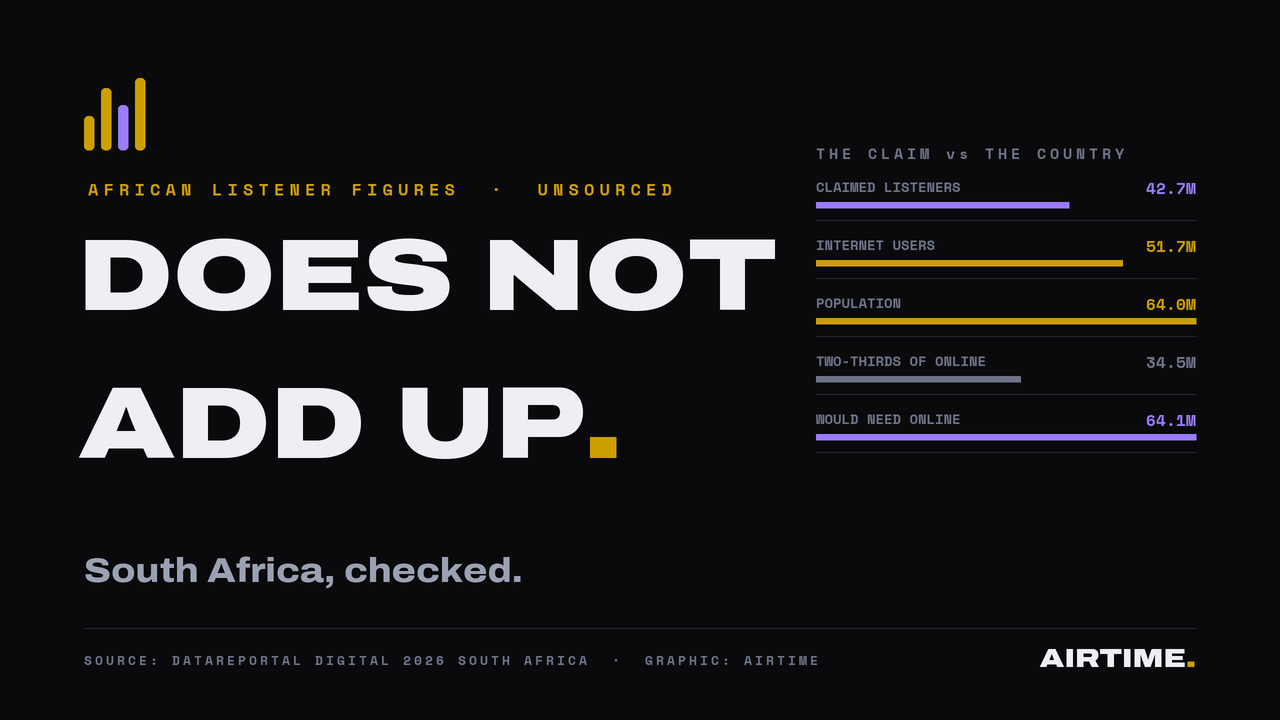
Three listener figures circulate widely in African podcast coverage: Nigeria around 80 million, South Africa 42.7 million, Kenya roughly 23 million. Traced to their most-cited appearance, they carry no attribution to any survey, panel or dataset. The South African figure is described as "about two-thirds of its connected audience", but two-thirds of South Africa's 51.7 million internet users is 34.5 million. For 42.7 million to be two-thirds, the connected audience would have to be 64.1 million, which is larger than the entire population.
Every industry has a set of numbers that everyone repeats and nobody opens. African podcasting has three, and they are worth opening.
The figures are that Nigeria has around 80 million podcast listeners, roughly 35 per cent of its population; that South Africa has 42.7 million, about two-thirds of its connected audience; and that Kenya has roughly 23 million. They appear in trade coverage, in pitch decks and in market summaries, usually with no source attached, in the tone of things already established.
We went looking for where they come from. The most-cited appearance is a Techloy piece from 5 November 2025. Read in full, the numbers sit there as bare statements. There is no named survey, no research house, no panel, no methodology and no link. Elsewhere the same article refers to "a 2025 regional estimate" without saying whose.
That alone would be reason for caution. What makes it worth writing about is that one of the three does not survive its own arithmetic.
For 42.7 million to be two-thirds of South Africa's connected audience, that audience would have to be larger than South Africa.
Take the South African claim at its word: 42.7 million listeners, "about two-thirds of its connected audience". According to DataReportal's Digital 2026 report, South Africa had 51.7 million internet users at the end of 2025, a penetration rate of 79.6 per cent, against a population of roughly 64 million.
Two-thirds of 51.7 million is 34.5 million. So 42.7 million is not two-thirds of the connected audience, it is about 83 per cent of it. Run it the other way and the problem is sharper: for 42.7 million to genuinely be two-thirds of the people online, the online population would need to be 64.1 million, which is more than everyone in the country. The figure and its own description cannot both be true, and the only reading that reconciles them requires universal internet access in a country where one in five people is offline.
The Nigerian number is not arithmetically impossible in the same way, but 80 million listeners would still represent a very large share of everyone online in Nigeria, and it arrives with the same total absence of sourcing.
Now the caveats, because this piece is about rigour and it would be poor form to skip them. We are not saying African podcast audiences are small. We do not know the real figures, and neither, as far as we can tell, does anyone quoting these. Techloy is not the origin of the numbers and does not deserve singling out; it is where they are most visible, and the same figures appear in plenty of other places with equally little attached. It is entirely possible a real study exists behind them and the citation has simply been lost through repetition, which is how most orphan statistics are born. And an unsourced number is not automatically a wrong number.
But an unsourced number is not usable either, and that is the practical problem. Advertisers price against these figures. Founders raise against them. Platforms decide where to open an office. A market that cannot say where its own headline numbers came from is a market making decisions on folklore.
This is exactly why Nigeria's podcast census matters more than its size suggests. It counted 329 shows, which is a far less impressive number than 80 million listeners, and it is worth incomparably more, because it says what it counted and how. We have now pulled four separate stories out of it precisely because its method is legible.
The honest position for anyone working in African audio right now is that we know how many shows Nigeria has, roughly, because one analyst counted them. We do not know how many people listen, anywhere on the continent, and we should stop pretending otherwise until somebody does that work and shows it.